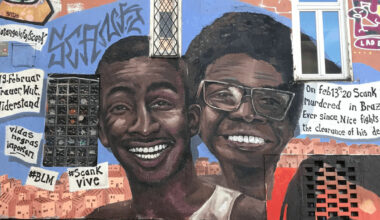
This mural, created by Tübingen artist Marvin Daumüller together with kollektiv orangotango and activists from Epplehaus, symbolizes not only Scank’s artistic legacy and Leonice’s struggle, but also that of all BPOC mothers around the world who fight for the lives and memory of their children and against racist hatred and policies that cement social inequalities.
The Tempelhof Field and Airport between Memory and Appropriation

A large part of Berlin’s population connects the Tempelhof Field and Airport with the Berlin Airbridge, wherby the place is characterized in the collective consciousness in the post-war period, especially […]
Tour on Upgrading, Displacment and Resistance in Kreuzberg
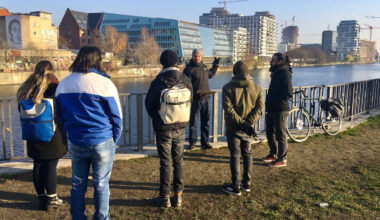
In this city walk we will take a look at the historical developments of this turbulent Berlin district in the post-war period and its transformation from a traditional working-class neighborhood […]
Confronting the Pandemic with a Geospatial View

The Panamerican Institute of Geography and History organizes a series of events on scientific answers to the Covid pandemic. We were pleased to take part in the first edition of […]
I Viaggi del Mammuttino
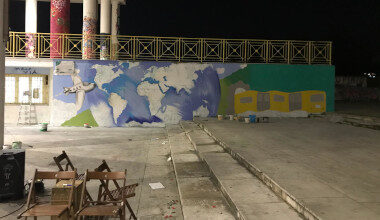
In early 2020, we painted a collective mural at the columns of Piazza Ciro Esposito, in the Scampia district of Naples, Italy. The mural tells the story of the Centro Territoriale Mammut and its struggle of appropriating public space through popular education.
A Right to a Garden City?

The urban gardens of Berlin exist under the recurring threat of closure. As part of the Gemeingut Grün Fact-Finding Committee at the Center for Art and Urbanism (ZK/U), Kerstin Meyer and Marco Clausen formulated a draft for a tenure treaty for Berlin gardens.
Body Mapping at Birmingham UCU Teachouts

As part of the Birmingham UCU Teachouts, we conducted the workshop “Bodies, Maps, Words: A Creative Writing Workshop” with James Lewis and Cristina Fernández Recasens. Starting from the question of how we unlearned to perceive geographical space through physical feelings and intentions by maps, we asked how we actually perceive and create university space with our bodies.
Solidarity and Assistance in Rio Grande do Sul

In the wake of the Corona pandemic, together with activist geographers of the UFRGS’s Geografia Litoral, we created this map to support solidarity organizing in Rio Grande do Sul.
eco*walking beyond – mapping, narrating

In December 2019, in cooperation with some of our long-time fellow academics, activists and friends, we organized a series of activities on mapping, walking and narrating urban space.
WIR BLEIBEN ALLE – Mural at Kreuzberger Waldemarstraße 81

In summer 2019, the collectives pappsatt and orangotango redesigned the old mural on the front of the building at Waldemarstraße 81 in Berlin-Kreuzberg together with the residents of the house. […]
Terminal Festival, Udine 2019
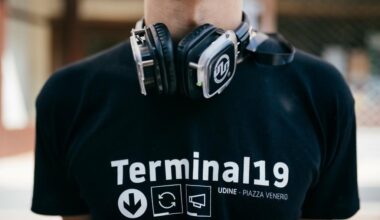
Das Terminal Festival in Udine, Italien vereint zeitgenössischen Zirkus, visuelle und performative Künste. Seit 2016 läd es einmal jährlich Künstler*innen und Bewohner*innen ein, sich gemeinsam auf unerwartete Reisen in und […]
Not-an-Atlas @ FoWe kritische Geographie 2019
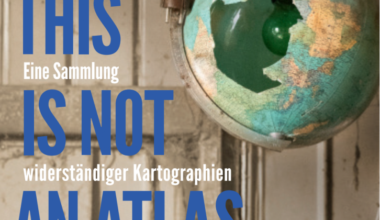
Seit Herbst 2008 findet regelmäßig die Forschungswerkstatt Kritische Geographie statt. Sie hat den Anspruch, einen Rahmen für eine explizit kritische Debatte raumbezogener Inhalte und selbstbestimmtes Lernen zu schaffen. Dieses Jahr […]
- « Previous Page
- 1
- 2
- 3
- 4
- …
- 6
- Next Page »